I chose the Blog Reader feedly to track ten library and education centered blogs. Historically I have not been one to follow blogs, but many of the blogs I came across are tied to Twitter accounts that I already follow or have found through Pinterest. I like the simple format of feedly and multiple viewing options. In the "title only" mode, the blog posts are listed to resemble an email inbox while the "pictures" mode, resembles Pinterest. I like the default "magazine" mode that shows a horizontal list of the most popular blog posts, followed by a vertical listing of posts by date. Each option allows you to hide posts so they disappear from view or save the posts so it can be easily accessed in the future.
Blogs I chose to follow:
http://librarymakerspace.blogspot.com
This blog is managed by a public library in Massachusetts that offers programming for adults, teen, and children. Their posts focus specifically on the maker movement, highlighting the activities they have featured in their library. Many of the posts revolve around 3D printing, which is not in the budget for my elementary campus but is interesting none the less.
http://frizzleblog.scholastic.com
Edu@Scholastic is a blog hosted by Scholastic Inc. that features articles on the issues and trends relating to literacy, teaching, early learning, family & learning, community and equity. The blog is specifically written for educators and school leaders.
http://lisnews.org
Library and Information Service News offers a link to wide variety of articles and blog posts relating to literacy and libraries. In the most recent listing, subscribers can find stories from national news outlets like CNN.com, regional newspapers like the Houston Chronicle, and college papers like the Stanford Social Innovation Review. The purpose of the blog is to offer a one stop shop for current news relating to libraries.
http://awfullibrarybooks.net
This blog is quite entertaining! It is designed for librarians to share the outdated and sometime ridiculous books they come across in their collection. The blog is managed by two librarians who have authored a book about the holistic approach to collection development. Librarians can submit a photo and description of the books they find in their collection and the two authors have a very witty way to feature each book.
https://www.nypl.org/voices/blogs/blog-channels/childrens-literature
The NY Public Library's blog offers book lists that are seasonally relevant, character features, book recommendations, author quotes. For anyone who loves children's literature, it is a great resource for what is current and relevant amongst young readers.
Others I chose to follow:
http://www.edudemic.com
http://www.thedaringlibrarian.com
http://ilearntechnology.com/wordpress/
http://www.edudemic.com
Thursday, October 6, 2016

Monday, September 19, 2016
Flexible Library Scheduling
I've come across a couple tweets referencing flexible scheduling and this is my way to keep track of them and their articles.
And a conversation about the pros and cons with a hybrid solution
Library Flexible Schedule: How to Make It Work https://t.co/B6H2vLnaO1 #txlchat #tlchat #istelib #edchat #txeduchat pic.twitter.com/xpMn7tCRlm— Nancy Jo Lambert (@NancyJoLambert) September 16, 2016
Taking the leap into flexible library schedule with our new school building. https://t.co/W552UkpbuU— Debi Fournier (@lattefriday) July 17, 2016
Pilot flexible library schedule! A Year of Change: After Two Trimesters https://t.co/KzUEQ6h2xS #tlelem @dsmacdonald @jenniferlagarde @— Beth Redford (@bethredford) March 22, 2016
And a conversation about the pros and cons with a hybrid solution
Flexible Scheduling vs Fixed Schedule? Maybe you should try a combo. http://t.co/OuQACtYios #library #tlchat #libchat— Shannon Thompson (@shnnnthmpsn) October 1, 2015
Saturday, September 10, 2016
Social Media and Libraries

The public school library pages I came across were well managed with some offering video book reviews by the librarian, photographs of students doing makerspace activities, and promotions for upcoming book fairs. While these pages were well done, they seem to generate very little traffic. In my experience, elementary school's parent organizations are more suited to the Facebook format and it is wise for teachers and librarians to collaborate with PTO/PTA's to reach parents and students. On the other hand, high school library pages on Facebook seem to more success in reaching out to students in order to promote the library as well as offering helpful tips for research, studying, etc.
Twitter offers educators a succinct way to share information, links, photographs and promotions. In my opinion, Twitter is set up in a way that gives librarians more control over the library's profile. Facebook allows posts by outsiders on a group's wall and it may be perceived as an endorsement or from the library itself. Twitter is more clear in its authorship. Another great benefit to Twitter is the ability to follow and connect with leaders in education and technology. This access allows a quick sharing of ideas and resources without creating yet another email. One such prevalent leader in educational technology is Jim Lerman who tweets often about a variety ed tech stories, links and how-to's. One such tweet on September 6th, Lerman connects followers to a article with a great list of tech tips for teachers.
Another leader in the library field is Linda Braun and her twitter feed is full of links and stories about after-school programs for students, the makerspace movement and online safety for teens. Here she links to a story about a school library capitalizing on the popularity of Pokemon go to connect students to STEM activities.Teacher Toolkit https://t.co/RVBM02g3wT pic.twitter.com/8hvDE6mGr8— Jim Lerman (@jimlerman) September 7, 2016
My school district encourages Twitter use for both librarians and teachers. Our library services department maintains an active and informative Twitter account (@KleinLibraries) recognizing individual campus library activities and sharing useful stories about the changing face of today's school libraries. While parents certainly enjoy seeing what their children are learning, I believe the greatest benefit has been the collaboration and sense of community it creates across our school district's many campuses.
Friday, April 15, 2016
Wonderstruck

Selznick, B. (2007). Wonderstruck. NY: Scholastic.
Wonderstruck brilliantly combines two seemingly unrelated stories, both in time and place, to tell a touching story of family and hope. This 600 plus page novel tells of Ben and his journey to find his place in the world without his mom, who recently passed away. Ben’s story is interrupted by Rose’s story, set 50 years earlier and told exclusively in pictures. Selznick's trademark pencil sketches are as integral to the story as his words and carry the story along visually without distracting from the plot. It is a compelling story of family, friendship, and unlikely connections.
Textbook Assignment #6
Comparison - Wonderstruck is unique to all of the books on our list in its format and theme. It is the only mystery and I found it to be the most captivating. Its text is conventional, while Love that Dog and Brown Girl Dreaming are poetic and El Deafo is a graphic novel. It is also the only book told in third person narration.
Appeal - while its size might be intimidating, upper elementary students could find it quite manageable and would probably enjoy carrying around such an impressive looking novel. As a librarian, I would feel compelled to warn the reader, as I was warned, that it might seem confusing as the two stories are being told but that it is worth it to see this one to fruition.
Three other books by Selznick include:
- The Boy of a Thousand Faces features the same black and white pencil style sketches seen in Wonderstruck, including many close up drawings of faces. Its main character is close in age to Ben in Wonderstruck, but the spooky theme and mysterious plot set it apart.
- The Houdini Box features another ten year old boy, but in this book the reader gets to see him grow up. Selznick’s style is set in this first novel with his pencil sketches telling just as much of the story as the text does. His illustrations are detailed, yet some only contain a hand waving or a foot climbing up stairs, just like in Wonderstruck.
- The Invention of Hugo Cabret is very similar to Wonderstruck in both size and style. The drawings tell the story and create a visual sense of mystery and wonder. These two books seem to have a genre of their own, as they can’t be defined as a typical novel or as a picture book. Like the other Selznick books, the protagonist is a young boy who has to find his own way.
https://www.youtube.com/watch?v=EBxghKUGkWk
Teaching Books link
https://www.google.com/?client=safari#q=wonderstruck+lesson+plan
Brown Girl Dreaming
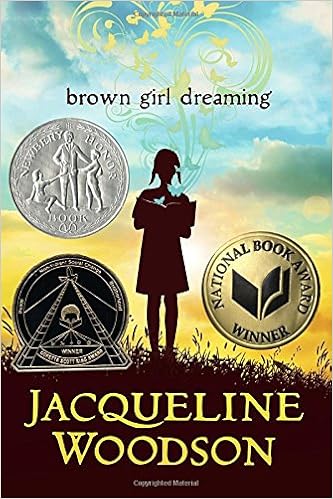
Woodson, J. ( 2014). Brown Girl Dreaming. New York: Penguin.
This beautifully written memoir tells of Jacqueline Woodson's childhood, her family's roots in both Ohio and South Carolina, and the family's progression that led them to New York. What a blessing to any family to have the stories and memories she recalls so eloquently. The collaboration of her aunts' memories and the perspectives of her brothers and sister takes the reader through this family's journey during a tumultuous time in our nation's history. Jacqueline was aware early on that her skin color made life different for her. Her poems tell of family, change, and life in the mid 1960’s and beautifully capture her memories in poetic verse.
Textbook Assignment #6
Comparison - Of the four books on our reading list, it is most similar to Love That Dog in its free verse poetry. Like in El Deafo, it similarly tells of the author’s childhood and touches on many serious subjects, like divorce, death, and racism.
Appeal - Regardless of race, this book captures the genuine thoughts, feelings, and innocence of a child. Woodson’s description of her close bond with her grandfather is one that many children will connect with. Her uncertainty of her place in the family or her value as a student are relatable and add to the authenticity of the story. As a librarian, I would be tempted to recommend this to a shy girl who hasn’t fully realized her true potential in the hopes that it would develop a sense of confidence and drive.
Three other books by Woodson include:
- If You Come Softly tells of an interracial relationship between two teenage prep school students, Jeremiah and Ellie. Woodson grapples with racism and a doomed relationship in this novel aimed at older students. Jeremiah is from Brooklyn which is an integral part of the setting in Brown Girl Dreaming but that is where the similarities end as this is a much more mature theme and subject matter.
- Feathers is a Newbury Honor book that also seems to focus on race in its descriptions of characters and their conversations. Like Brown Girl Dreaming, it is told from the perspective of a young girl so the reader has access to her thoughts and feelings. Both books have undertones of religion and make references to the historical events of the time.
- Peace, Locomotion shares the same lyrical language that Woodson is known for in this second novel about Lonnie, or Locomotion. He and his sister, Lili, live in separate foster homes after the death of their parents. Written as a series of letters from Lonnie to Lili who are dealing with their separation and their new families. It deals with a disconnected family like Woodson’s own family, as documented in Brown Girl Dreaming.
Book Trailer
https://www.youtube.com/watch?v=FHNXWSAsoyY
Teaching Books link
http://www.teachingbooks.net/tb.cgi?tid=39186&a=1
Tuesday, April 12, 2016
Love That Dog

Creech, S. (2001). Love that dog. NY: HarperCollins.
Love that Dog is one side of a poetic conversation between Jack and his teacher. Jack is a talented poet, even though he is a little unsure of himself. His teacher, Miss Stretchberry, introduces the class to many new poems and Jack shares his thoughts on each poem with her. Creech perfectly captures the voice of young Jack in his realistic take on poems and his witty dialogue with his teacher. When he hears a poem by Walter Dean Myers, he is inspired to write about his dog and even reaches out to Myers himself. Jack gains confidence in himself and his writing as this quick, delightful story progresses.
Textbook Assignment #6
- Comparison - Creech’s free verse is similar to Woodson’s Brown Girl Dreaming in both form and perspective. Although it’s structure is completely different than El Deafo, it is similar in its humor and voice. Both Jack and Cece are navigating relationships with teachers and classmates.
- Appeal - As a former Bluebonnet award winner, Love that Dog an easy sell in the library. A book of poems might not typically appeal to boys, but the main character Jack and his love for his dog can capture a larger audience. Given the fact that there is a sequel also adds to saleability of the book.
- Three other books by Creech include:
Hate That Cat involves the same character, Jack’s, written conversation with his teacher Miss Stretchberry. It’s a new school year and she has moved up with him to a new grade and they seem to pick up right where they left off. Jack and Miss Stretchberry have a good relationship and his entries to her are quite entertaining.
The Boy on the Porch is a story of a young couple who find a boy has been left on their porch and he doesn’t speak. This book is very different from the previous two as it is written in a narrative form and involves a family rather than a singular character.
The Unfinished Angel is a narrative about an angel who is awaiting her instructions and floats above an Italian town observing the crazy people below. This novel is a departure from the other Creech books mentioned with its flair for magic and fantasy but it shares the author’s sense of humor and charm.
Book Trailer
http://www.schooltube.com/video/fe84d972d6a3a2e2987c/Love-That-Dog-Book-Trailer
Discussion Guide
http://www.scholastic.com/teachers/lesson-plan/love-dog-discussion-guide
El Deafo

Bell, C. (2014). El Deafo. New York: Abrams.
El Deafo is a graphic novel that tells the story of Cece, a deaf girl who experiences life with the help of a magic phonic ear. This autobiographical retelling of Cece’s childhood captures the ups and downs of a girl who struggles to fit in and find a true friend. Cece loses her hearing at a young age due to illness and has to learn to adapt to life at home and school with her new limitations. Despite the serious subject matter, there is times when this book is laugh-out-loud funny as Cece shares her perspective on childhood in the mid 70's. Any reader would find enlightenment on the topic of hearing impairment and how the deaf manage to function in the hearing world.
Textbook Assignment #6
- Comparison - This book has similarities to Woodson’s Brown Girl Dreaming as it shares the author’s childhood experiences in a unique way. The mid 1970’s time period is set about a decade after Woodson, but is similar to Selznick’s story of Ben in Wonderstruck. Of the four books on our list, it is the only graphic novel and I found this one to be the most humorous. Bell’s descriptions of one of her classmates as “kinda pushee” and being able to overhear the teachers talk about their students in the teacher's’ lounge is hilarious.
- Appeal - El Deafo has wide appeal as a graphic novel. The charming illustrations and depiction of Cece and her friends as rabbits creates a fun reading experience, despite the serious, genuine feelings experienced by Cece as she struggles with her complete hearing loss. Any child who suffers hearing impairment will relate to Cece’s frustrations in dealing with the hearing world. I would recommend it to any family members, friends, or teachers of a hearing impaired student as it an eye-opening glimpse into their everyday challenges.
- Three other books by Bell include:
Rabbit & Robot: The Sleepover is ideal for a young audience with its simple dialogue and illustrations. It tells of the unlikely friendship between a rabbit and a robot and how the two manage to work through their differences. That is a similar problem in El Deafo as Cece tries to get her friends to understand her hearing loss and magic ear.
Sock Monkey Series is a three book collection of the adventures of the sock monkey. These books, all picture books, share Bell’s quirky storytelling but in an entirely different format than El Deafo’s graphic novel.
Itty Bitty tells of a tiny dog who makes his home inside an enormous bone. Also a picture book, this story is aimed at the preschool audience and stands alone in the collection of Cece Bell’s books.
Book Trailer
https://www.youtube.com/watch?v=ljJ0JbtQoEA
Teaching Books Link
http://www.teachingbooks.net/tb.cgi?tid=40736&a=1
Subscribe to:
Posts (Atom)