Tuesday, March 8, 2016

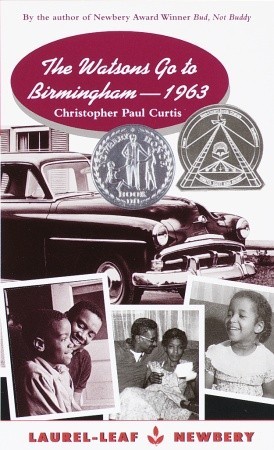
The Watsons go to Birmingham, 1963


Curtis, C.P. (1995). The Watsons go to Birmingham. 1963. NY: Delacorte.

      I love historical fiction and I love this book! The Weird Watsons are quite entertaining and seeing their adventures through the eyes of the middle child, Kenny, had me laughing and forcing my own kids to read about their antics. My favorite part of the story is when Byron was setting fire to the toilet paper parachutes in the upstairs bathroom. Mama had made it clear that she was fed up with Byron and he was about to get it! Curtis does such a great job of describing Mama's rage, Byron's fear, and Joetta's panic as Mama is determined to teach him a lesson by burning him, but only a little! Joetta cannot help herself but to blow out that match each time, momentarily diffusing the situation. The up and down of everyone's emotions in this scene are contagious. 
      This book touches on the turmoil of race relations in the 1960's but I love that most of the story is about this funny family, struggling to raise their children. By the time the Watsons find themselves in Alabama, the reader has grown quite attached to this fun-loving family. This makes the climax of the Birmingham church bombings that much more intense, as the reader worries for Joetta's safety. In the end, the trip to Birmingham greatly affects Kenny as he deals with what he witnessed that day. This book is an entertaining way for students to study a difficult time in our nation's history. 


Textbook Assignment #4

Being the middle child isn’t easy. Kenny Watson has an older brother who enjoys terrorizing him any chance he gets and a sister who just wants everyone to get along. Living in Flint, Michigan in 1963, the Weird Watsons have no shortage of crazy stories to tell, usually revolving around their oldest son Byron. The laid back dad and no nonsense mom are at their wit’s end with Byron’s disobedience and it’s time to get serious. Kenny’s narration takes the reader through the misadventures of Byron Watson, including freezing his lips to the car mirror, setting things on fire in the upstairs bathroom, making unapproved purchases at the local market, and failing 5th grade, again. His parents have threatened many times to ship him off to his grandmother’s house in Alabama but this time they mean business. Dad spends a small fortune to fix up the family’s car, the Brown Bomber, for the summer road trip, yet Byron still doesn’t believe he’s going anywhere. Kenny, on the other hand, is too excited about the trip to even sleep! Despite mom’s careful planning, dad intends to drive straight through to prove that both he and the Brown Bomber can handle the nearly 20 hour drive. Through this change in setting, the reader has the advantage of seeing the difference between the north and the south in their treatment of African Americans. Life in the south is very different than in Flint and the dangers that blacks faced in Alabama become very real to Kenny and his family. Through Kenny’s eyes, the reader becomes witness to the horrors of the 1963 Birmingham bombings. The historical significance of this book makes it a must read for all students. Curtis perfectly captures the voice for each of the five, very unique characters. That, blended with a carefully crafted background story, leads up to an intense climax followed by a heart-warming resolution.

Lesson Plans:
https://www.killeenisd.org/teacherDocs/c49/e19863/documents/TheWatsonsGoto-77577.pdf

http://www.walden.com/watsons-go-to-birmingham-7-creative-classroom-activities/


Friday, March 4, 2016

Orbiting Jupiter


Schmidt, G. (2015). Orbiting Jupiter. NY; Clarion Books

      Joseph comes to live with Jack's family and he seems to be hiding many secrets. Jack's simple life is changed with the addition of this strange boy with a strange past, but he immediately trusts Joseph and wants to help him anyway he can. This is an interesting story where the readers immediately ask themselves, what would I do in Jack's shoes or how would I treat Joseph. Fortunately for Joseph, Jack's parents and a few teachers at school see potential in him and encourage him to dream of greater things. Joseph has suffered and his only focus is finding his daughter, allowing him a life with hope and a piece of the love he lost. This tragic story leaves you saddened by the unfair reality Jack and his family are left with, while also reminding you that all is not lost as a new family has been created. 

Textbook Assignment #3

Evaluative Criteria - Characters

       The reader sees everything through the eyes of Jack, including his perception of the events and his take on the characters in this story. His inability to adequately describe some moments, such as when Joseph walks out onto the frozen river or during the fight in the locker room, demonstrates a response appropriate to a 12 year old boy. Jack leads a simple life, until Joseph comes to live with his family. Jack is immediately open to Joseph and there is never a hint of distrust or resentment on Jack’s part. He is immediately likable for his kindness and empathy. Joseph is, in every way, more complicated. When he finally opens up, it is a relief to Jack, his parents, and the reader. The compassionate teachers, Jack’s gracious and patient parents, and the social worker are all willing to help Joseph but many times, he is his own worst enemy. The horrible assistant principal and Joseph’s abusive father offer a balance in personalities and remind the reader of how cruel the world can be.

Evaluative Criteria - Plot

       Gary Schmidt tells a complicated and heart-breaking tale, yet the simple elements such as the milking of cows and walking to school offers a sense of calm to the complexity. Jack and Joseph’s relationship is difficult and they struggle to define it, but as the story builds there is a depth of understanding that neither expected. It is through this connection that the story is fully told. Joseph’s past is not as black and white as it might have seemed and he is a victim of many unfortunate events. His determination to stay focused on his daughter drives the plot and his father’s greed takes the story to it’s climax. Ultimately, it is a sad, beautifully told story of what might have been.  

Book Trailer by author
https://www.youtube.com/watch?v=CRCXc1QQv9M


Wednesday, March 2, 2016

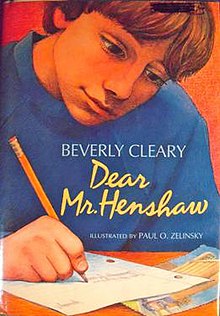
Dear Mr. Henshaw


Cleary, B. (1983). Dear Mr. Henshaw.  NY: Morrow

       Being a kid of the 80's, this is a book I owned as a child but I'm not sure I ever read the whole thing. I never could relate to a boy struggling with his parent's divorce so it never hooked me. As an adult I can appreciate why this 30 year old book would find its way on a reading list for a children's literature class. Leigh was clearly seeking out some fatherly advice in his letters to fictional author Boyd Henshaw. Mr. Henshaw's advice to start a journal would benefit any child but especially one who is struggling with a family disruption. Leigh finds his voice and his confidence in the series of letters and journal entries. Leigh's personal growth in this book would make for a good character study and the conflict resolution would be a great classroom conversation of a realistic conclusion to the problem facing Leigh's family and many others.

Textbook Assignment #3
Evaluative Criteria #1 - Style

      In Leigh’s collection of letters and diary entries, we see him transition from a second grader who loves a book about a dog to a middle schooler struggling to cope with his parents’ divorce. Cleary’s use of this style allows the reader to understand Leigh’s feelings in a way that is unique for a first person narrative. It is in these letters to author Boyd Henshaw that Leigh finds his voice and through the diary entries he comes to grips with the difficulties both at home and school. Cleary perfectly captures the emotions, thoughts, and wit of Leigh Botts in this coming of age tale with its own unique, timeless style.

Evaluative Criteria #2 - Theme

     Leigh goes from being a happy kid living with his parents and his dog to a kid who is lonely and struggling to figure out what happened to his happy family. The theme of divorce and adjustment is one that many kids can understand. The conflicting feelings Leigh has for his dad are honest and relatable. His frustration with circumstances he cannot control give him a focus in his writing without weighing down the plot. In the end, Leigh comes full circle in his acceptance of his parent’s divorce and reluctantly begins to embrace his new normal.  

Teaching Books
http://www.teachingbooks.net/tb.cgi?tid=1759&a=1


Monday, February 22, 2016

Crossover

Alexander, K. (2014). Crossover. New York: Houghton Mifflin Harcourt

      Presented in a variety of poetic forms, Crossover tells the story of twin brother Josh and Jordan Bell, their basketball player dad and their assistant principal mom. The rhyme and verse set the tone for this family and their world as it revolves around basketball. Their enjoyment of music creeps its way into the poetry and many pages read like a song. Each turn of the page reveals a new style of verse without losing any rhythm in the plot or distracting from the characters. Kwame Alexander managed to capture the essence of basketball, family and heart in this innovative approach to poetry and it is a masterpiece. 

Textbook Assignment #3

Evaluative Criteria #1 - Style
   The lines and rhymes in Crossover have such a melodic quality that the words seem to float off the pages. Alexander’s use of poetry is an interesting approach to a book about basketball, but it works and the result is phenomenal. The book reads like a narrative but each page is different from the next in its presentation. From rhyming poems to conversations only consisting of questions, Alexander has exposed the reader to a wide variety of poetry styles. This would make a great book study for a mid-level English class because of its integration of so many excellent writing styles in one, powerful story.  

Evaluative Criteria #2 - Characters

Josh Bell, aka Filthy McNasty, is known for his long hair, his famous dad, and his own impressive basketball skills. He has a strong bond with his family, is a good student, and basketball is his life. His twin brother Jordan, or JB, shares most of these traits, except for the hair. These brothers are inseparable until a girl gets in the way and the dynamic shifts. Josh struggles to deal with his jealousy and new-found loneliness, while also trying to balance his worry for his dad and keeping his mom happy. The boys and their dad share a love for basketball and music, but are also refreshingly well rounded in their interests and values. Dad’s obsession with basketball permeates everything he does and his stubbornness creates conflict for his family. Mom rounds out the family as the no nonsense boss who adores her boys and her husband. Kwame Alexander has portrayed a healthy, relatable family unit that takes the reader on a wild ride of emotions.

Review and Study Guide
http://www.bookrags.com/studyguide-the-crossover/#gsc.tab=0

Book Trailer
https://www.youtube.com/watch?v=BONWz5Ao82E


George


Gino, A. (2015). George. NY: Scholastic

      When I started this book, I was determined to keep an open mind. I didn't tell my family what the book was about because I didn't want any opinions or outside distractions, it was just me and George. I almost dared this book to change my mind and really hoped it would offer me some insight and compassion for a topic that goes against my personal beliefs.  George is a boy who feels he really is a girl. The use of the feminine pronouns helps the reader think of him as a girl, but it would be very confusing to a young reader. I found much of the dialogue between George and his best friend Kelly to be very unrealistic for ten year old conversation, especially considering Kelly is basically raising herself. I found the plot to be rather dull. I was not particularly captivated with whether or not George would get to read the part of Charlotte in the play. The most climactic elements for me were waiting for George to tell Kelly and his family his secret. 
      Personally, I live with a ten year old boy and so many times while reading this book I wondered if Alex Nino has spent much time with 4th graders. With some exceptions, they aren't as complex as George and Kelly. Much of George's thought processes and feelings felt way too advanced while the absence of his father was handled very flippantly.  In the end, I can see why people would feel that this book breaks barriers and explores new topics not usually seen in children's literature. For me, I looked past the story and characters and saw an author with an agenda who used a strange platform. 

Textbook Assignment #3

Evaluative Criteria #1 - Gender and Culture
        In a moment of time where a famous male athlete now identifies as a female, George certainly finds itself as a relevant topic in today’s culture. The main character, George, feels he is a girl and is, throughout the book, referred to with feminine pronouns. The gender differences between boys and girls are a constant source of confusion for George and are explored in depth in both George’s thoughts and conversations with best friend, Kelly.  The discussion of femininity and sexuality are hot topic issues in today’s culture.
Evaluative Criteria #2 - Theme
   Alex Nino explores a theme in George that is rarely discussed in children’s literature. George is weighed down with the burden of feeling like he really is a girl and therefore, has difficulties in every aspect of his life. George struggles to truthfully communicate with his mother, to connect with his older brother, and to feel comfortable in his own body. The risk of such a theme is that it might be difficult for many children to relate or simply understand the character. The use of female pronouns in reference to George would be very confusing for young readers to follow and George’s obsession with all things feminine might struggle to appeal to its intended audience.

Friday, February 12, 2016

Bridge to Terabithia


Paterson, K. (1977). Bridge to Terabithia. NY: HarperCollins

     Jesse Aarons starts 5th grade with one goal, he wants to be the fastest kid in the school. This is finally his year and he's worked all summer to make sure he's faster than anyone else. Little does he know that his new neighbor Leslie, a girl who doesn't look or act like any other girl he's met, is about to derail his plans. Jesse's life is not easy. His parents are struggling financially, his house is overrun with sisters, and he seems to be the only child required to help around the house and farm. Despite his best efforts to be cold to Leslie, he finds himself with a new best friend and a new secret world to share with her. The two create the magical land Terabithia and it is there that their friendship grows. Jess finds a kindred spirit in Leslie as they share a passion for creativity, something that Jess's father doesn't appreciate. Leslie's lack of fear worries Jess while he struggles to understand his own excess of fear. Ironically, this leads to tragedy and Jess has to face the reality of loss, confusion, and healing. 

Textbook Assignment #3

Evaluation Criteria #1 - Setting
   Jesse and Leslie’s lives, set out in a remote area, offer the perfect setting for these two friends to explore, find seclusion, and create the world of Terabithia. It is there that Jesse finds a kindred spirit in Leslie and where the two find true friendship. The setting plays an integral role in the plot and we first see this through Jesse’s desire to be the fastest kid in the school. The hours spent running in the open field outside his home showcase his determination. This is also where Jesse first glimpses his new neighbor Leslie, who eventually ruins his quest to be the fastest kid. While the story shifts to school and back home, the characters and the plot develop in the time spent in Terabithia. It is ultimately the landscape and force of nature that concludes this story in a tragic way.    
Evaluative Criteria #2 - Plot
    The storyline involving Jess and Leslie is told logically and in a believable way. When Jess chastises himself for being selfish, it comes across as appropriate for a 10 year old boy who is old enough to know he shouldn’t only think of himself. Leslie is an extraordinary girl who is wise and full of a spirit of adventure. It is the pairing of these two kids that creates a realistic plot full of situations that many ten year olds will understand. They team up to survive the school bully, entertain themselves during the long afternoons at home and fill the voids left by their families. With the exception of one minor foreshadow, the plot twist near the end is just as unexpected for the reader as it is for the characters in the story.
Lesson Plan:
http://www.readwritethink.org/classroom-resources/lesson-plans/exploring-friendship-with-bridge-981.html?tab=4#tabs
Book Trailer
https://www.youtube.com/watch?v=_WA8-hRFs50


Tuesday, February 9, 2016

Primates


Ottaviani, J. (2013). Primates. NY: FirstSecond.

     Jane Goodall, Dian Fossey, and Birute Goldikas and their work with primates are creatively portrayed in this informational graphic novel aimed at kids in the middle grades. The cartoon-like depictions draw in readers to a world of science and research sprinkled with humor and charm. Ottaviani doesn't shy away from the realities of their lives and the difficulties they faced, both as women in a male dominate world or in the complications that come with life in the African bush.This group biography succeeds in introducing the reader to these three admirable women in an entertaining and accessible way. 

Textbook Assignment #2
Evaluative Criteria - Design

     The format and presentation of Primates is that of a graphic novel aimed at older children or young adults. The life stories of these three women are laid out in comic style pages with conversational and sometimes humorous dialogue. Covering these three primatologists’ work and accomplishments, Jim Ottaviani and Maris Wicks have treated a new generation of readers to the world of primates. Their focus seemed to be on the overall design in hopes of appealing to a broader audience. The dialogue is not overly scientific and, at times, a work of fiction but the material covered and the style of presentation is enough to pique the interest of any scientist or animal lover.

Teaching Books
http://www.teachingbooks.net/tb.cgi?aid=11716&a=1&a2=1

Book Trailer
https://www.youtube.com/watch?v=0jLASr1Abmg